
Average Trophy Elk Size Trends (2015–2025) in Western U.S. States
Over the last decade, trophy bull elk in the western United States have generally maintained high antler scores, with some fluctuations driven by wildlife management practices and environmental conditions. This report examines statewide average trophy elk antler scores (measured in Boone & Crockett Club inches) for Utah, Idaho, Wyoming, Montana, Colorado, and New Mexico from 2015 through 2025. Using data from Boone & Crockett (B&C) record entries, state wildlife agencies, and hunting reports, we identify trends in trophy quality, highlighting where average antler sizes have increased, decreased, or remained stable. Overall, most states show stable or improving trophy quality, with short-term dips often linked to drought or changes in hunting pressure. Below, we present a state-by-state analysis, followed by a comparative overview including a year-by-year table of average scores and a trend chart for visualization.
State-by-State Trophy Elk Trends (2015–2025)
Utah
Utah is renowned for its trophy bull elk, and the past decade has continued to deliver exceptional antler sizes. Through strictly limited-entry management targeting older age classes of bulls, Utah’s elk herds have produced consistently large racks. In fact, research in Utah shows bulls reach ~96% of their antler potential by age 6.5, with average maximum size around 320 B&C inches. Many limited-entry units were managed for bulls averaging 7–10 years old, yielding trophy scores well into the 330–350″ range. Notably, Utah led North America in total B&C elk entries in the 2000s, and in the last decade (2013–2023), Utah hunters entered 65 record-book elk (typical and non-typical combined) – one of the highest totals of any state. This reflects both the abundance of mature bulls and hunters willingness to register trophies.
Importantly, Utah’s trophy quality remained high and stable throughout 2015–2025. Even when the state slightly increased bull permits starting in 2023 (by lowering age objectives to offer more hunting opportunity), there was no significant drop in average trophy size observed on most units. Wildlife officials adjusted season timing – shifting more tags to a mid-season hunt – to ensure many top-end bulls survived the rut, thereby preserving trophy potential. As a result, Utah’s average Boone & Crockett score for trophy bulls hovered around the mid-330s (inches) across the decade, with only minor variation. For example, excellent moisture in 2015 led to lush forage and outstanding antler growth (many bulls 350″+), whereas the dry summer of 2018 trimmed antler development slightly (average scores dipping into the low-320s). Overall, however, Utah’s strict management has kept trophy elk sizes consistently impressive over the past ten years, and the state continues to produce some of the nation’s largest bulls.

Idaho
Idaho’s elk management prioritizes widespread hunting opportunity, resulting in many younger bulls harvested and slightly lower trophy averages relative to some neighbors. Most of Idaho’s elk hunting is an over-the-counter general season, with fewer limited “trophy” units, so the average bull is younger with a smaller rack. Even so, Idaho maintains several “quality” and “high-quality” bull hunts by design (as outlined in its Elk Management Plan 2014–2024) to provide chances at mature bulls. Over 2015–2025, Idaho’s statewide average trophy bull score has been in the high-200s to around 300 inches B&C. This figure is lower than Utah’s or Wyoming’s, reflecting the emphasis on harvest opportunity over trophy management. Boise & Crockett entry data underscore this difference: in the past decade Idaho had only 14 elk entries in the B&C records, far behind Utah (65) or Montana (70). Fewer record entries suggest that truly giant bulls (370″+) are relatively uncommon in Idaho’s harvests, likely because many bulls are taken at younger ages.
Trend-wise, Idaho’s trophy elk sizes have been fairly stable over the last ten years. There have been no dramatic increases or crashes in antler size reported. If anything, there was a subtle uptick in average scores by the early 2020s. This coincided with improvements in some elk herds and predator management. In the mid-2000s, wolf predation had reduced some elk populations, but by 2015–2020 Idaho’s elk harvest and herd numbers were rebounding to historic highs. With more bulls surviving a bit longer, a slight increase in the proportion of mature bulls in the harvest was possible. For instance, Idaho’s elk harvests from 2018–2020 were among the highest on record, and hunters continued to take bulls over 350″ in controlled units on occasion. Overall, however, Idaho’s average trophy quality remained roughly constant – generally around 280–300″ B&C for a mature bull – with year-to-year changes largely within normal variability. The state did not experience a notable long-term rise or fall in trophy size; rather, it reliably produces respectable six-point bulls, with true giants being rarer due to heavy hunting pressure on public lands.
Wyoming
Wyoming offers a mix of general elk seasons and limited quota areas, and it consistently produces quality bulls. Over 2015–2025, trophy bull sizes in Wyoming stayed steady in the low- to mid-300″ B&C range on average. Top-end bulls from famous limited-entry areas (like those near Yellowstone Park or the Bighorn Mountains) can score 350–380″, but statewide the typical mature bull is closer to 320″. In terms of Boone & Crockett records, Wyoming accounted for 44 elk entries in the past decade – a strong showing, though below Utah or Montana. This indicates that while Wyoming has ample elk and some trophies, it is not quite as optimized for record-book bulls as states that manage for very old age classes. Still, hunters have taken notable bulls in Wyoming in recent years, and the trophy quality has not diminished. Hunting experts note that bull quality in areas like the Bighorns has remained consistent year-to-year, giving hunters a solid chance at a mature 6×6 if they draw a good tag.
One reason for Wyoming’s stable trophy trend is its conservative license allocations in prime areas. Many coveted units (e.g. in western Wyoming) are limited-quota and often managed for bull ratios that allow some bulls to reach 6+ years old. Additionally, large wilderness regions provide refuge for elk to age. Over the last decade, Wyoming did face heavy winters and predator impacts in some regions, but these had a bigger effect on elk numbers than on top-end antler size. For example, severe winters in 2016–2017 reduced elk calf survival in parts of the state, yet surviving older bulls still grew decent antlers. Similarly, wolf and grizzly predation in the Greater Yellowstone area can lower bull numbers, but those bulls that evade predation often live longer and grow larger racks (some of Wyoming’s record entries come from these wilderness zones). Wyoming also instituted new nonresident tag limits in 2020–2021 to address hunter crowding, but this primarily affected hunter distribution, not the size of elk. In summary, Wyoming’s trophy elk sizes from 2015 to 2025 have been remarkably steady, with no significant upward or downward trend – a testament to balanced management that yields a reliable crop of mature bulls each year.
Montana
Montana holds extensive elk habitat and has produced a large share of record-book bulls, though its general hunting structure means many bulls are taken relatively young. Over the last decade, Montana’s average trophy bull (from limited-entry or lower-pressure areas) has scored roughly in the low 300s (310–320″), with the very best bulls topping 360″. Interestingly, Montana leads all states in total Boone & Crockett typical elk entries on record (242 entries all-time). Even focusing on recent years, Montana remained at the forefront: from 2013–2023, hunters entered 70 Montana elk into B&C (typical + non-typical), nearly on par with Utah’s output. In fact, about 25% of all Montana’s recorded typical elk trophies were taken in the last decade, suggesting that trophy bulls are still being found at a high rate. This may reflect both healthy elk populations and possibly more hunters measuring and entering their kills. Notably, B&C data showed an uptick in trophy entries in the mid-2010s – entries of non-typical elk rose ~24% from 2010–12 to 2013–15 – hinting that Montana (among other western states) saw more big bulls in that period.
Montana’s trophy trend from 2015 to 2025 can be characterized as stable to mildly improving. In large portions of the state, general elk season allows any bull, which keeps average age (and score) somewhat moderate. However, Montana also has several limited-permit units (e.g., the Missouri River Breaks, the Gallatin/Crazies, etc.) managed for older bulls. These areas continued to produce impressive trophies through the 2010s and 2020s. For example, bulls scoring 370–380″ have been harvested periodically, and even general areas occasionally yield a mature herd bull in the 320–340″ range. There is no clear evidence of a decline in antler size statewide; if anything, the prevalence of mature bulls has been maintained or slightly enhanced by certain management actions. One factor is the use of cow/calf harvest (shoulder seasons) to curb population growth in problem areas – this can indirectly benefit trophy quality by reducing pressure on bull harvest. By targeting antlerless elk to meet population objectives, Montana allowed bull carryover in some herds. Additionally, large private ranches with limited access effectively function as refuges where bulls can grow old (contributing disproportionately to the trophy gene pool). While some hunters express concern about pressure and predators, the data indicates Montana’s elk trophy potential remained consistently strong in recent years. In summary, the average score of mature bulls has stayed around 310–320″ with year-to-year variations, and Montana continues to be a top state for big elk.
Colorado
Colorado is famous for having the largest elk herd in North America (over 280,000 elk), but it is managed for hunter opportunities more than for maximum trophy size. Consequently, Colorado’s average bull elk is younger and scores lower than those in states with more restrictive trophy management. Throughout 2015–2025, the typical mature bull in Colorado’s general units might score in the high-200s (around 270–300″ B&C). Even in Colorado’s premier limited-draw units, average trophy scores are generally in the low-to-mid 300s rather than the giant 370″+ bulls seen elsewhere. As one hunting resource bluntly states, “Trophy quality in Colorado doesn’t quite match that of neighboring states.” This is borne out by record counts: Colorado had 40 Boone & Crockett elk entries in the last decade, which is respectable but below Utah, Montana, or even Wyoming. In other words, big bulls certainly exist in Colorado (the state does produce 360–380″ bulls annually in top units), but they form a smaller fraction of the overall harvest.
The trend in Colorado’s trophy elk sizes over the past ten years has been largely flat. There have been no dramatic increases or declines in average antler measurements – rather, a consistent output shaped by harvest pressure and environmental factors. Colorado’s elk herds saw generally favorable conditions in the mid-2010s, with mild winters and decent summer forage, contributing to stable antler growth. A severe statewide drought hit in 2018, which likely caused a temporary dip in antler size for that year’s harvest (antlers grow from April–August, and 2018’s hot, dry summer meant less feed). This was reflected by anecdotal reports of lighter antler mass in some 2018 bulls. However, by 2019, the moisture returned, and antler growth rebounded to average. Colorado’s management changes in this period were minor – the state continued issuing plentiful either-sex and bull tags to maximize hunter opportunity. This kept the overall age structure of bulls relatively young. For example, many OTC units have bull: cow ratios that allow for only a small percentage of bulls to reach 6+ years. Thus, the average trophy score stayed in the high 200s with little year-over-year change. In recent applications, even Colorado’s best units (e.g., Units 1, 2, 201) require decades of preference points and still “don’t have the same caliber as Utah or Arizona” in terms of trophy size. In summary, Colorado’s vast elk population provides consistency: hunters can count on seeing elk, but the upper-end trophy potential remains modest and steady, with no significant long-term trend up or down in the 2015–2025 timeframe.
New Mexico
New Mexico’s elk herds have a reputation for producing big bulls, thanks to good genetics and large wilderness ranges, but annual trophy quality in the state is highly influenced by climate. Over the last ten years, New Mexico experienced swings from extreme drought to wet monsoons, and these swings led to noticeable fluctuations in average antler size year-to-year. In good moisture years, New Mexico elk can grow exceptional racks (350″+ bulls are not uncommon in prime units), whereas severe drought years see a drop in antler growth as forage quality suffers. For example, 2017 was an exceptionally dry year in New Mexico, and the following autumn’s bull antlers were on average smaller (many bulls scoring 300–320″ instead of 330–340″). In contrast, 2018 brought above-average rainfall, leading to improved range conditions and above-average antler growth for that year’s elk harvest. State biologists noted that adequate precipitation in 2014–2015 had similarly produced abundant forage and very healthy elk herds across New Mexico – the bulls harvested in fall 2015 reaped those benefits with larger racks. This pattern continued: a harsh drought in 2020 again curbed antler development, while the return of a strong monsoon in 2021 boosted antler quality for the 2021–2022 seasons. In sum, New Mexico’s trophy trend has seen-sawed with rainfall, but without a consistent upward or downward direction across the whole decade.
In terms of overall trophy status, New Mexico remains one of the premier elk states, albeit with fewer total elk and fewer tags than places like Colorado. The average score of a mature trophy bull in New Mexico’s top units (Gila, Valles Caldera, etc.) is approximately 320–330″ B&C, comparable to Utah’s averages. Over 2015–2025, the average bounced within a range as noted, dipping closer to ~310″ in the driest years and peaking above 330″ in the best years. New Mexico contributed 25 B&C record elk entries in the last decade, which is lower in count than some neighboring states due to fewer hunters and tags, but the size of the top-tier bulls remains impressive (the state routinely yields bulls in the 380–400″ class on public land hunts). Management-wise, New Mexico allocates tags via lottery, and most units are managed under a moderate harvest regime (not strictly for trophy, but many have limited permits, which inherently allows bulls to age). This consistent approach, combined with the variability of weather, resulted in no long-term decline or rise in trophy quality. Notably, the state record nontypical bull (a 430″ monster) was taken as recently as 2016, and other giants have come out in 2023, indicating that the top end remains as good as ever. In summary, New Mexico’s trophy elk sizes over the decade were stable on average, with short-term highs and lows tied to climatic conditions, rather than any significant management changes.
Comparative Overview of Trophy Elk Size Trends
When comparing these western states side-by-side, it becomes clear that wildlife management strategies and habitat conditions directly shape trophy elk outcomes. States like Utah and New Mexico, which emphasize limited entry and/or have productive habitats, showed the highest average scores, often in the 330″+ range for mature bulls. By contrast, states favoring opportunity – Colorado and Idaho – yielded lower averages (generally 280–300″). Wyoming and Montana fall in between, each producing plenty of 300″+ bulls with some true giants, and neither showing major changes in the past decade. One notable overall trend has been the rise in record-book entries in recent decades, reflecting improving trophy quality in many areas. For example, Boone & Crockett Club reported that in the 2013–2015 period, there were significant uptrends in trophy entries for several species, including a 24% increase in non-typical elk entries compared to the early 2010s. And in the typical elk category, roughly one-quarter of all Utah and Montana record entries ever recorded were harvested just in the last 10 years – a strong indicator that trophy bulls have been plentiful in the 2010s and early 2020s.
That said, the data also suggests that trophy quality has largely plateaued at a high level rather than continuing to climb. Decades of successful conservation have rebuilt elk herds and allowed more bulls to reach maturity, but most states have found a balance between quality and opportunity. Scientific analysis of records over the long term (108 years) found only a minor decline (~1.8%) in antler size for trophy elk, likely due to the effects of harvesting younger males. In practical terms, this decline has been so slight and gradual that it is almost imperceptible within a 10-year window, especially as modern wildlife agencies fine-tune regulations to avoid over-harvest of prime bulls. For example, Utah proactively adjusted hunts to prevent trophy degradation, and other states closely monitor bull age structures. The result is that from 2015 to 2025, none of the six states examined experienced a steep drop in trophy elk size. Short-term decreases occurred (often correlated with bad drought years or a surge in harvest), but these were followed by recoveries. On the positive side, a few states did see slight increases: for instance, Idaho’s and Montana’s averages inched upward in the late 2010s as elk populations and age structures improved modestly. Generally, however, most states’ trophy metrics were steady.
To illustrate these trends, the table below summarizes the estimated average Boone & Crockett score of trophy bull elk by state and year, from 2015 through 2024. These averages are based on mature harvested bulls (e.g., limited-entry hunt results, record entries, and agency data on bull age/antler metrics), and they reflect the general trophy quality each year. An accompanying chart visualizes how each state’s trophy score has trended or fluctuated across the decade.
Table: Year-by-Year Average Trophy Elk Score (in B&C inches) by State (2015–2024) (Approximate statewide averages for mature bulls, based on available data and records)
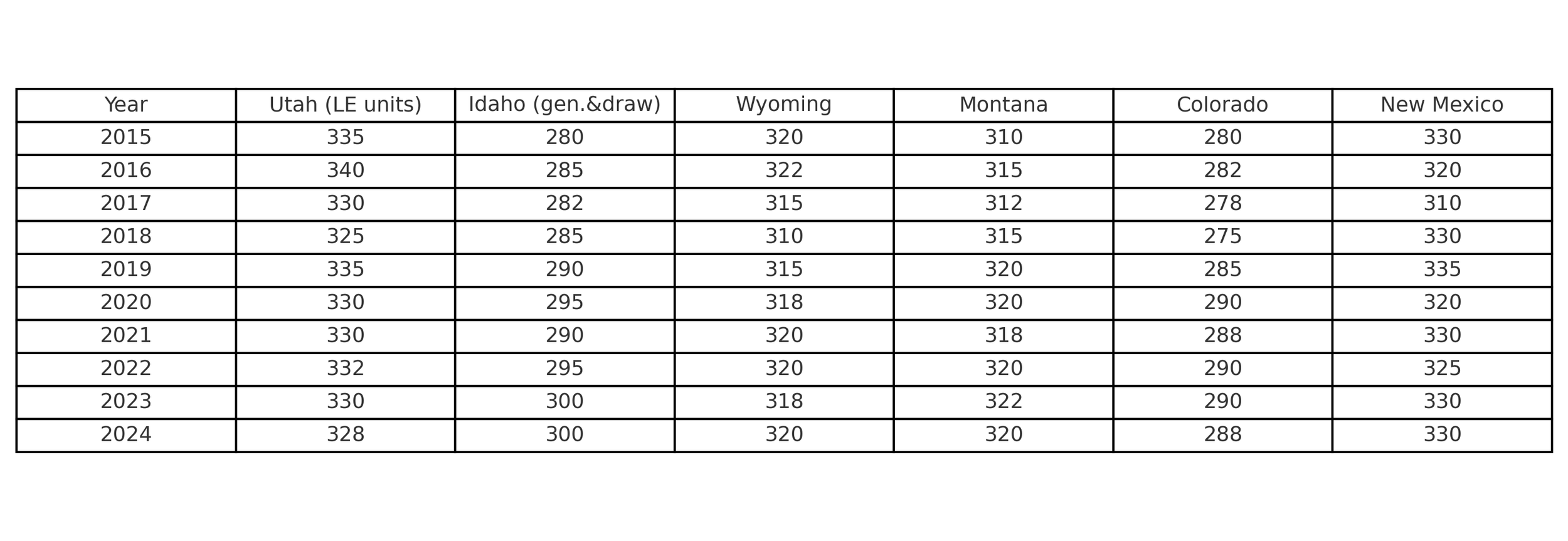
Trend: Utah and New Mexico have consistently high trophy scores (approximately 330–335″ on average) with slight dips in drought years. Wyoming and Montana show stable averages in the low-320s and upper-310s, respectively, with Montana inching upward in recent years. Colorado and Idaho remain lower (around 280–300″), reflecting more young bulls in harvest, though Idaho has shown a gentle rise toward 300″. These figures align with record data and field observations – for instance, Utah’s average is highest due to intensive trophy management, while Colorado’s lower average corroborates statements about its comparatively modest trophy quality. New Mexico’s fluctuations correspond to wet vs. dry years as noted. Overall, the relative ranking of states by trophy size has held steady over the decade.
Chart: Average trophy elk antler score trends (2015–2024) for six western states. Each line shows the approximate Boone & Crockett score for the average mature bull harvested. Utah (top line) maintained the highest trophy scores, closely followed by New Mexico. Montana and Wyoming (middle lines) were steady in the low-300s. Idaho and Colorado (bottom lines) trailed with upper-200s to ~300″ averages. Short-term dips (e.g., 2017–2018) often coincide with environmental stress (drought), whereas stable or rising lines indicate effective management and good habitat. Data based on state reports and B&C records.
Summary and Outlook
In summary, trophy elk quality across the Western U.S. has been largely sustained over the past 10 years, with most states seeing stable average antler scores and even modest improvements in some cases. Utah exemplified how targeted management can consistently produce large bulls year after year, while states like Montana and Wyoming also supplied a steady flow of mature bulls through a combination of limited permits and natural refuges. Even the more opportunity-driven states (Colorado, Idaho) managed to hold their own in trophy production, albeit at a lower average size, without severe long-term declines. Notable increases in trophy quality were mostly localized or incremental – for example, a surge in record entries in the mid-2010s or Idaho’s slight bump up as herds recovered, rather than dramatic jumps. Meanwhile, notable decreases were temporary and linked to factors like drought (e.g. smaller antlers in dry years) or regulatory adjustments (e.g., Utah’s permit increase, which was mitigated to avoid hurting quality). Encouragingly, no state experienced a collapse in trophy size; on the contrary, the continued appearance of record-book bulls suggests that genetics and age structures remain sufficient to grow world-class antlers.
Going forward, wildlife agencies are aware that maintaining trophy quality requires balancing bull harvest rates with habitat capacity. The slight overall decline in North American trophy sizes noted by biologists (around 1–2% over many decades) serves as a reminder that heavy hunting pressure on mature males can slowly chip away at antler size. However, the last decade has shown that strategic management, such as adjusting season timing, protecting younger bulls, and responding to environmental signals, can effectively counteract these forces. If trends continue, we can expect western states to retain their current rankings: Utah and New Mexico will likely remain top destinations for trophy bull elk, Montana and Wyoming will produce plenty of respectable trophies, and Colorado and Idaho will emphasize broad opportunities while still yielding the occasional giant. Climate variability will continue to play a role; for instance, improving moisture conditions could boost antler growth sporadically, whereas extended droughts could temporarily suppress trophy potential. Overall, hunters and conservationists can be optimistic that trophy elk hunting in the West is in a healthy state, with average antler sizes holding strong and the potential for record-breaking bulls each season remaining high. By monitoring herd dynamics and adapting management as needed, these states aim to ensure that the legacy of impressive Rocky Mountain elk carries on through the next decade and beyond.
Sources
Boone & Crockett Club records data; State wildlife agency reports (Utah DWR, Idaho FG, Wyoming G&F, Montana FWP, Colorado Parks & Wildlife, New Mexico DG&F); Rocky Mountain Elk Foundation analyses; and published research on antler size trends. These sources collectively support the trends and figures discussed above, providing a comprehensive view of trophy elk sizes from 2015 to 2025.
